When you select a unit to fight, it first Piles In, then its models make melee attacks, then the unit Consolidates.
Use the following sequence when a unit fights.
When a unit Piles In, you can move each model in that unit that is not already in base-to-base contact with an enemy model up to 3"– this is a Pile-in move. For a Pile In to be possible, a unit must be able to end these moves within Engagement Range of one or more enemy units and in Unit Coherency. If these conditions cannot be met, no models in the unit can make Pile-in moves this phase and you progress to making melee attacks with that unit. Otherwise, the unit can make Pile-in moves.
Each time a model makes a Pile-in move, it must end that move closer to the closest enemy model. If it can also end that move in base-to-base contact with one or more enemy models while still satisfying all of the conditions above, it must do so. The controlling player chooses the order in which to move their models.
Pile-in Move: Up to 3".
Every model that moves must end closer to the closest enemy model, and in base-to-base contact with an enemy model if possible. The unit must end in Unit Coherency and within Engagement Range of at least one enemy unit (or no models can Pile In).
When a unit makes its melee attacks, before resolving those attacks you must first determine which models can fight, then select which melee weapon each of those models will make attacks with, then select the targets for those attacks.
Which Models Fight
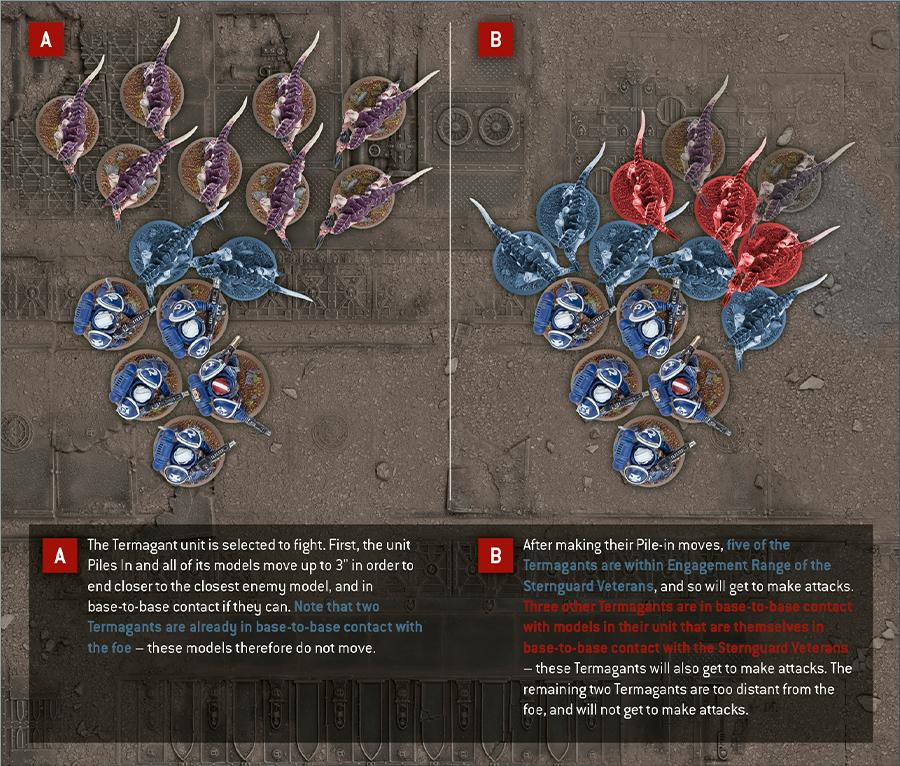
When a unit makes its melee attacks, only models in that unit that are either within Engagement Range of an enemy unit, or in base-to-base contact with another model from their own unit that is itself in base-to-base contact with an enemy unit, can fight.
A model can fight if it is within Engagement Range of an enemy unit.
A model can fight if it is in base-to-base contact with another model from its own unit that is itself in base-to-base contact with an enemy unit.
Select Weapon
When a model fights, it must do so using a melee weapon it is equipped with. The weapons a model is equipped with are described on its datasheet. If a model has more than one melee weapon, it can only use one of them to make attacks with each time it fights, so you must now declare which it will use before resolving any of its attacks.
If the selected weapon has more than one profile to choose between, a model can only use one of them to make attacks with each time it fights, so you must also declare which profile it will use before resolving any of its attacks.
When a model fights, it will make a number of melee attacks determined by the Attacks (A) characteristic of the melee weapon it is using.
Each model makes a number of attacks equal to the Attacks characteristic of its selected weapon.
Each model that can fight does so using one of its melee weapons.
Select Targets
Before you resolve any melee attacks, you must first select the enemy units that will be the targets for all of those attacks. In order to select an enemy unit as the target of a melee attack, the attacking model must be either within Engagement Range of that enemy unit, or in base-to-base contact with another model in its own unit that is itself in base-to-base contact with that enemy unit.
If the melee weapon a model is using to fight with can make more than one attack, those attacks can all be made against the same target, or they can be split between different targets. Similarly, if a unit has more than one model, each model can make its attacks at the same, or different, targets. In either case, declare which attacks will target which units before any attacks are resolved.
If there are no eligible targets (because there are no enemy units within Engagement Range, for example) then that unit cannot make melee attacks this phase, but it can still Consolidate (see below).
Attacking model must either be within Engagement Range of an enemy unit to target it, or in base-to-base contact with another model in its unit that is itself in base-to-base contact with that enemy unit.
Select targets for all attacks before any are resolved.
Make Attacks
Melee attacks follow the same attack sequence as ranged attacks (see Making Attacks section), and you make one Hit roll for each attack being made.
If more than one enemy unit has been targeted by an attacking unit’s melee attacks, resolve all of the attacks against one target before moving onto the next.
If your unit is making attacks with more than one melee weapon against a unit, and those weapons have different profiles, then after you have resolved an attack with one of those weapons, if any other weapons with the same profile are also being used to make attacks against that unit, you must resolve those attacks before resolving any other attacks against the target.
Note that all of the attacks you have declared targets for are always resolved against the target units, even if, when you come to resolve an attack, no models in the target unit of that attack remain within Engagement Range of the attacking model’s unit (because of models being destroyed as the result of other attacks made by the attacking model’s unit, for example).
All attacks declared against a target unit are resolved, even if no models in that unit remain within Engagement Range.
Resolve all attacks against one unit before moving onto the next.
Resolve all attacks with the same weapon profile before resolving any made with a different weapon profile.
After a unit has finished making all of its melee attacks, it Consolidates. Each time a unit Consolidates, you can move each model in that unit that is not already in base-to-base contact with an enemy model up to 3"– this is a Consolidation move. For a Consolidation to be possible, a unit must be able to end these moves within Engagement Range of one or more enemy units and in Unit Coherency. If these conditions cannot be met, then each model in that unit can instead make a Consolidation move towards the closest objective marker, but only if, after doing so, that unit is within range of that objective marker and in Unit Coherency. If these conditions also cannot be met, no models in the unit can make Consolidation moves this phase and that unit’s fight ends.
If a unit can end its Consolidation within Engagement Range of one or more enemy units, then each time one of its models makes a Consolidation move, it must end that move closer to the closest enemy model. If it can also end that move in base-to-base contact with one or more enemy models while still satisfying all of the conditions above, it must do so. The controlling player chooses the order in which to move their models.
If the above is also not possible, no models can Consolidate.
If the above is not possible, each model can move towards the closest objective marker, but this must result in the unit being within range of it and in Unit Coherency.
Every model that moves must end closer to the closest enemy model, and in base-to-base contact with an enemy model if possible. The unit must end in Unit Coherency and within Engagement Range of at least one enemy unit if possible.
Consolidation Move: Up to 3".
